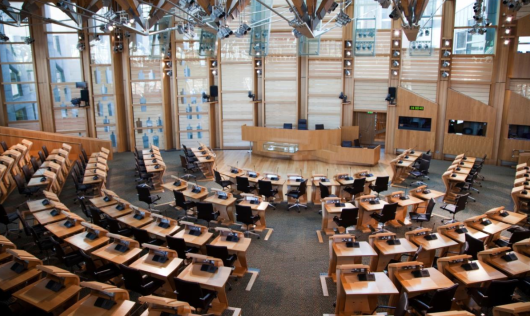
The Horticultural Trades Association is calling on the Scottish Government to use its 2027–28 Budget on 3 December to reduce barriers to investment, back Scottish businesses and harness the economic benefits of Scotland’s environmental horticultural sector, which promotes biodiversity, supports local communities and improves the nation’s health and wellbeing.
The HTA’s budget submission to the Deputy First Minister of Scotland and Cabinet Secretary for Finance and Local Government states that improving financial support for small businesses and prioritising water resilience, peat-free growing, energy efficiency, automation, and technology are crucial not only to future-proof the sector but also to equip businesses to deal with the challenges they face today.
Environmental horticulture and landscaping currently contribute £2.6 billion to Scotland’s GDP and support 59,700 jobs. In a letter to Jenny Gilruth MSP, ahead of the Budget on 3 December, the HTA has highlighted that those economic benefits could rise to £5.1 billion by 2030 with the right policies in place.
The Association – which represents more than 85 businesses across 144 sites in Scotland, including garden centres, growers, landscapers, designers and manufacturers - is urging the Scottish Government to support member businesses to grow, design, deliver and maintain Scotland’s green infrastructure by investing in green businesses, reducing financial and regulatory barriers, improving climate resilience and ensuring the resources to deliver a UK-EU SPS Agreement and export growth.
Fran Barnes, Chief Executive of the Horticultural Trades Association (HTA), said: “Scottish horticultural businesses, the majority of which are small and family-owned, are facing significant financial pressures from surging costs in fuel, employment, business rates, and energy. Regulatory demands are also intensifying, making it even harder for these businesses to thrive. That’s why we’ve written to the Cabinet Secretary for Finance, calling for action ahead of the Scottish budget in early December.
“Some of our members have reported dramatic increases in employment-related costs. One Scottish Garden Centre reported that National Insurance contributions and changes to the National Living Wage had increased its associated costs from £8,000 to £26,000. The current business rates system in Scotland also puts them at a disadvantage, as most garden centres are too large to qualify for existing relief schemes. Despite some government support, such as the Small Business Bonus Scheme and RHL relief, many businesses still cannot benefit.
“We need the Scottish Government to create a more competitive environment, provide support for Scottish growers to invest in things like water storage, renewable energy, automation, unlock growth opportunities, and change policies so our much-loved family businesses achieve long-term sustainability. It’s also vital that the Scottish Government recognises the wider value of gardens, trees and green spaces. Investing in greener communities will not only strengthen economic growth and improve productivity but also increase climate resilience and support the nation’s health.”
Highlights from the HTA’s Scottish Budget Submission
The HTA calls for action in the following eight key areas:
- Deliver a business rates system that does not undermine competitiveness across the four nations
The Small Business Bonus Scheme may benefit some of the very smallest businesses, but the size of garden centre/retail nurseries usually pushes them over the threshold for accessing this support. Scotland’s Retail, Hospitality and Leisure (RHL) Relief Scheme is about 40% of the equivalent RHL relief scheme which was introduced in England from April 2026. The HTA warns that if inequality in business rates persists, it will drive some companies south of the border, undermining Scotland's economic growth potential.
- Introduce a ‘Greening’ Business Rates Relief for those which incorporate and maintain at least 0.5 hectares of green space on site
Trees and plants provide effective shade, with one large tree cooling its surroundings by the same amount as ten air conditioning units working simultaneously. In the HTA’s recently published report, The Value of Green Spaces, it also states that access to green spaces makes people healthier, happier, more creative and more productive. It also reduces workplace absence.
- Invest in Scottish tree and plant growers so that more green infrastructure can be grown in Scotland
UK environmental horticulture supplied £1.6 billion of plants, trees, flowers and bulbs in 2025 with UK growers eager to deliver more. Growers, while keen to invest, often cannot raise the capital required quickly enough, especially given the volatility of weather-related demand. The Scottish Government’s vision is to expand woodlands to cover 21% of Scotland’s land area by 2032. To deliver this, Scottish tree growers need multi-year funding certainty, including ringfenced maintenance budgets for any planting, with grants that are aligned with targets. A clear focus on delivery, including setting targets for urban planting, and measuring survival rates must be prioritised.
- Press the UK Government for an immediate review of Statutory Sick Pay (SSP)changes.
The Employment Rights Act has added considerable cost and additional administrative burden on businesses. While the HTA supports measures that provide fairness and certainty for workers, it is important that the UK Government analyse the impact on businesses as a result of the Employment Rights Act to date. Given increased costs to businesses, and irregularity within the SSP system, the Scottish Government should push the UK Government for an immediate post-implementation review with a view to updating how SSP is calculated as soon as possible.
- Establish a cross-government horticulture taskforce and develop a Scottish Horticultural Growth Strategy.
The growth of the sector will help to make communities more resilient and maximise the delivery of cross-departmental policy aims. To support this, the Scottish Government should build on the UK Government's work on the Horticulture Sector Growth Plan, identify where Scottish growers' needs differ, and develop a Scottish Horticultural Growth Strategy to grow the sector’s businesses.
- Include non-black recyclable plastic plant pots in kerbside collections across Scotland in the upcoming Household Recycling Code of Practice.
Around 300 million plant pots reach UK households each year. Non-black polypropylene pots are designed to be recyclable, but inconsistent kerbside collection means this valuable material can be lost from the circular economy. Without wider collection, horticultural businesses across the UK could face an estimated £750,000 in additional Extended Producer Responsibility fees each year. This will free up funds that can be invested elsewhere in the business and support the delivery of the government’s circular economy ambitions.
- Protect and increase funding for Social Therapeutic Horticulture services and facilities to deliver long-term health and economic benefits
85% of Scottish adults say green spaces are good for their mental health, and 77% agree they benefit their physical health. Trellis’ GP Pilot Trial in East Lothian, which ran throughout 2025/26, saw a 67% reduction in GP appointments in the three months after the programme ended, reducing waiting time for other patients and highlighting the power of therapeutic horticulture as a health intervention. There is a clear economic incentive to deliver this, and the HTA calls on Ministers to build on the pilot project to raise the profile of social and therapeutic horticulture, and suggests ringfencing funding for green social prescribing services, including Social Therapeutic Horticulture and training for practitioners, and embed social and therapeutic horticulture in core offerings made by GPs across Scotland.
- Ensure the implementation of a UK–EU SPS agreement is adequately resourced and build back supply chains and growing UK exports
Work with the sector to design and deliver a horticultural export strategy following the UK-EU SPS negotiations. Close collaboration with DEFRA will be required on the processes and systems needed to implement the SPS Agreement, ensuring they work for businesses across the UK.
The HTA Policy and Public Affairs team advocate for members across the devolved nations. To find out more about their work in Scotland, visit: hta.org.uk/policy/devolved-nations or download the Scottish Budget Submission.