Urban greening is increasingly recognised as essential infrastructure — helping cities address rising temperatures, flooding, biodiversity loss, and public health challenges. Yet in many sustainability frameworks, the contribution of plants remains fragmented, inconsistently measured, or treated as a secondary consideration.
For the International Association of Horticultural Producers (AIPH), this gap presents a growing challenge for cities seeking not only to deliver greener, healthier, and more resilient urban environments, but also to measure, evaluate, and improve their long-term impact.
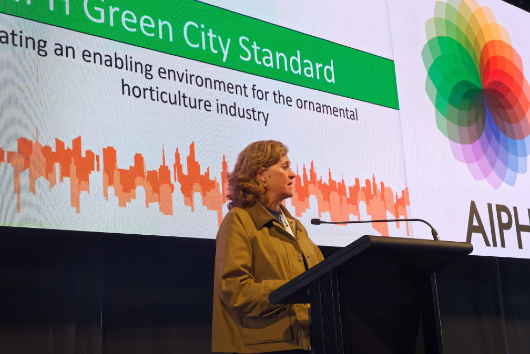
Dr Audrey Timm, Technical Initiatives Manager at AIPH, says the AIPH Green City Standard was developed in response to the growing need for clearer and more consistent ways to evaluate how plants and nature contribute to urban resilience and liveability.
“It became obvious that the world had no shared language for understanding what good urban greening actually looks like,” Timm notes. “Even the cities doing exceptional work couldn’t benchmark themselves in a meaningful way.”
This thinking shaped the AIPH Green City Standard — a framework tested with a diverse group of pilot cities and designed to help cities worldwide evaluate how effectively plants and nature are integrated into urban policy, planning, and investment.
The development of the AIPH Standard builds on AIPH’s wider Green City programme, including the AIPH World Green City Awards, which have highlighted growing international demand for clearer benchmarking, measurable outcomes, and shared learning between cities.
Rather than focusing solely on ambition or individual greening initiatives, the AIPH Standard encourages a more holistic and measurable approach to plant-centred urban development.
It is designed not simply as a prescriptive checklist, but as a framework that helps cities better understand how successful outcomes are achieved, supports continuous improvement, and enables shared learning across different urban contexts.
Cities begin with self-assessment through AIPH’s digital insight platform and receive tailored feedback to help identify strengths, gaps, and opportunities for improvement. Independent external audit and verification form a fundamental part of the Green City Standard, ensuring a credible, transparent, and internationally robust process. Certification is intended not as an endpoint, but as a milestone within a continuous cycle of learning and improvement.
As international focus on urban resilience continues to grow, the role of plants within sustainability assessment frameworks is increasingly critical — not only in improving urban environments, but in helping cities demonstrate long-term impact and accountability.
Timm offers a final reflection. “Cities are becoming harder places to live. If we can help them use nature not as ornament but as strategy — and do it systematically — the impact could be transformative for millions.”
Read the full article to explore why cities are increasingly seeking more robust ways to measure the impact of urban greening, the key reasons a city would say yes to adopting a common framework, and how the AIPH Green City Standard will evolve over the next decade to help shape greener, healthier, and more resilient urban development worldwide.
To read the full article, Raising the Bar: Why the World Needs a New Standard for Green Cities, visit: Raising the Bar: Why the World Needs a New Standard for Green Cities • AIPH
Cities and partners interested in engaging with the AIPH Green City Standard ahead of its official launch are invited to register their interest with AIPH: greencity@aiph.org