Speakers explored how better information, smarter production systems, and evidence-based approaches can help growers respond to increasing commercial, environmental, and plant health pressures at the AIPH Horticultural Industry Conference.
Better data, stronger science, and closer collaboration across the horticultural value chain will be essential to helping growers improve productivity while responding to increasing sustainability and plant health demands was the key message at the AIPH Horticultural Industry Conference, part of the International Association of Horticultural Producers (AIPH)’s 78th Annual Congress in Bari, Italy.
The Growing Productivity and Growing Sustainably sessions brought together international experts to examine some of the practical challenges facing ornamental horticulture, from digitalising nursery operations and assessing the environmental impact of growing media to managing emerging plant health threats and reducing the impact of crop protection.
Turning farm data into better decisions
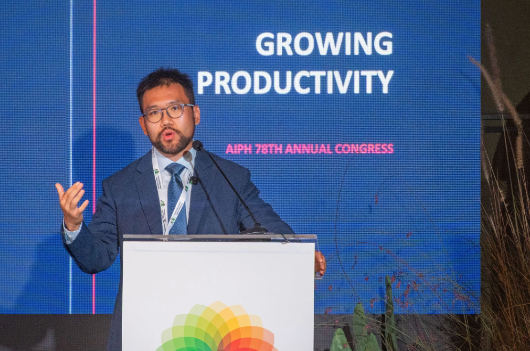
Rick Yin, Founder and CEO of Bornsuntech Smart Agriculture Company in China, explored how digitalisation can help horticultural businesses move from experience-led towards increasingly data-informed production.
Yin argued that productivity begins with visibility. By capturing information across areas including crop production, labour, finance, pest management, and post-harvest operations, growers can better understand what is happening within their businesses and identify opportunities for improvement.
Artificial intelligence can then help analyse this information, identifying patterns and providing insights to management teams. However, Yin stressed that technology is an enabling tool rather than a replacement for people. “AI never works alone. It’s helping our management team to become better,”he said.
Successful digitalisation, he added, depends on making systems straightforward for people to use and embedding them into everyday operations. Rather than attempting wholesale transformation immediately, businesses can begin with specific operational challenges before progressively building a culture of measurement, review, and continuous improvement.
Looking beyond simple sustainability claims
Dr. Alexander Sentinella, Director of Science, Growing Media Europe, turned the discussion towards one of horticultural production’s most important inputs: growing media. He challenged the industry to think more carefully about what is meant by “sustainable growing media”, arguing that sustainability cannot be adequately understood by considering a single material or environmental indicator.
A meaningful assessment needs to consider environmental, economic, and social sustainability, alongside the performance of growing media within the wider production system. Crucially, growing media must also be assessed according to what it enables growers to produce. Its quality can influence yield, crop losses, water and fertiliser use, meaning a material with a lower environmental footprint in isolation could ultimately result in a greater overall impact if crop performance declines.
The need for robust evidence is becoming increasingly important as regulation around environmental claims develops. Dr. Sentinella urged businesses to understand precisely what their sustainability claims measure and ensure they can be substantiated, rather than relying on broad terms or individual characteristics such as “peat-free” as proxies for sustainability.
Strengthening plant health through international cooperation
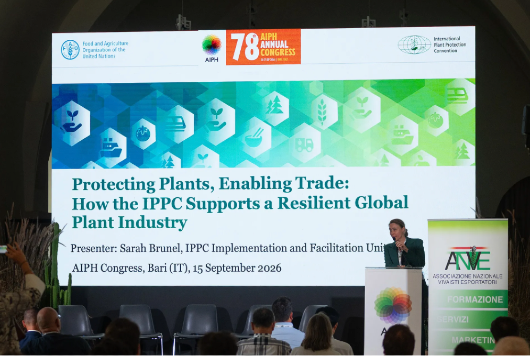
Plant health brought another dimension to the sustainability discussion. During the Growing Sustainably session, Sarah Brunel, Implementation and Facilitation Lead of the International Plant Protection Convention (IPPC), highlighted how international cooperation can help protect plant health while facilitating safe trade.
Brunel explained that the risks posed by plant pests are increasing as globalisation and climate change create new opportunities for pests to spread. For an industry dependent on the international movement of plants and plant material, effective phytosanitary systems are therefore fundamental to both protecting production and maintaining access to markets.
She also highlighted the importance of preparedness and early action. Through its Pest Outbreak Alert and Response Systems programme, the IPPC is working towards a global early-warning system for emerging pests, helping countries identify threats, share information, and respond before outbreaks become more difficult and costly to manage. Growers and other industry professionals have an important role to play as a first line of detection by identifying and reporting unusual pests rather than allowing potential threats to go unnoticed.
The importance of collaboration between international bodies, regulators, and the horticultural industry was reflected in AIPH’s own work to strengthen plant health management across the sector. Technical Initiatives Manager Dr. Audrey Timm updated delegates on AIPH’s work towards a unified framework for an externally audited systems approach to plant health management in ornamental horticultural production.
International trade depends on the movement of plant material across borders, making strong biosecurity systems essential both for protecting plant health and maintaining trade. AIPH has worked with representatives of six existing plant health standards to develop a unified framework that could provide the basis for new industry standards while aligning with regulatory requirements and supporting international trade.
Learning from 13 years of Xylella
The complexity of balancing biosecurity with proportionate regulation was illustrated by Dr Donato Boscia, Research Manager at the Institute for Sustainable Plant Protection, Italian National Research Council, who reflected on more than a decade of experience with Xylella fastidiosa in Europe.
First detected in southern Puglia 13 years ago, the bacterium has had severe economic, environmental, landscape, and social consequences, particularly through its impact on olive production. It has also created significant challenges for nurseries through restrictions on the movement and marketing of plants, additional testing requirements, and changes to production protocols.
However, Dr. Boscia explained that experience accumulated since the original outbreak has revealed a considerably more complex picture, with different subspecies and strains presenting different levels of risk to different plant species.
He argued that this growing body of scientific evidence should inform increasingly targeted approaches to management and regulation. Rather than applying the same measures universally, he advocated risk assessment based on individual strains and local epidemiological conditions.
“The adoption of targeted and case-by-case adapted management measures is needed, rather than a one-size-fits-all approach,” he said.
Finding a workable path for crop protection
Stephanie Miltenburg, Head of Public Affairs at Royal FloraHolland, presented the Netherlands’ new sector-wide agreement aimed at reducing the environmental impact of crop protection across plant-based agricultural sectors.
The agreement brings together government, industry, and other stakeholders around shared responsibilities, combining environmental objectives with economic viability, innovation, and a national approach to policy. Importantly, it shifts the emphasis from simply reducing the use of individual crop protection products towards reducing their overall environmental impact.
Miltenburg highlighted the importance of developing viable alternatives alongside greater environmental ambition, ensuring that policy is supported by independent science and recognising that growers cannot deliver the transition alone. She commented: “Sustainable crop protection is not only about reducing environmental impact, it’s about finding solutions together that work for growers.”
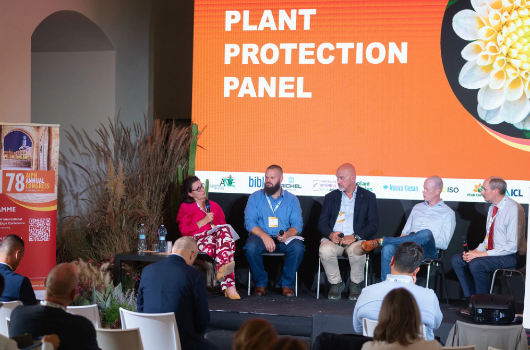
These issues were explored further during a panel discussion bringing together perspectives from growers, crop protection specialists, certification providers, and industry representatives.
Panellists highlighted a common challenge across different markets: conventional crop protection products are becoming less available, while biological and other alternatives are not always reaching growers at the same pace. In Brazil, for example, growers face challenges accessing registered products for the comparatively small ornamental horticulture market, while European producers face an increasingly restricted conventional toolkit.
The discussion also highlighted the progress already being made. Growers are increasingly adopting biological controls, improved monitoring, integrated approaches, and new technologies, while industry organisations are working to improve access to alternative products and provide growers with the technical support needed to make the transition.
Across both sessions, speakers returned repeatedly to the importance of evidence. Whether deciding how labour is deployed, selecting growing media, responding to a plant health outbreak, or reducing the environmental impact of crop protection, reliable information allows growers and policymakers to understand the consequences of their decisions.
For ornamental horticulture, becoming more productive and becoming more sustainable are therefore not separate ambitions. Both depend on production systems that are measurable, adaptable, scientifically informed, and capable of supporting growers as they respond to a rapidly changing operating environment.
Recordings from the AIPH Horticultural Industry Conference will shortly be available online. Sign up to AIPH’s newsletter to receive the latest news, resources and updates: Subscribe to the AIPH Newsletter