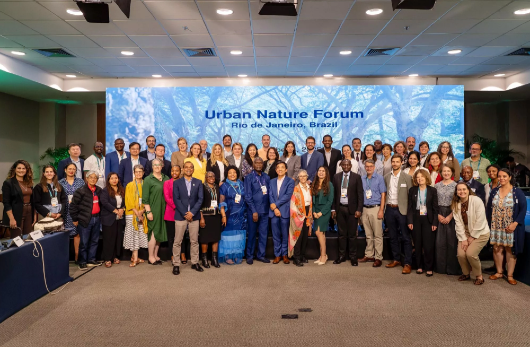
The International Association of Horticultural Producers (AIPH) strengthened its global leadership in urban greening recently, as Dr Audrey Timm represented the organisation at high-level international events in Rio de Janeiro, Brazil – the C40 World Mayors Summit and COP30 Local Leaders Forum, and the World Bank’s Global Platform for Sustainable Cities (GPSC) Mayors Round Table and Urban Nature Forum.
Across both events, AIPH introduced the AIPH Green City Standard — a major new global initiative currently in its consultation phase, designed to help cities redefine how they plan, measure, and invest in urban greening.
The events brought together mayors, ministers, financial institutions, urban planners, architects, climate leaders and city networks from around the world to advance a shared vision for nature-positive, resilient cities ahead of COP30 in Belém, Brazil.
Speaking on behalf of AIPH at the World Bank Urban Nature Forum, Dr Timm introduced the AIPH Green City Standard as a governance-based, plant-centric global benchmark designed to help cities connect ambition with measurable progress.
“We join this Forum with a shared, essential vision: to make nature the core, working infrastructure of every city. We see amazing projects, but they are still too often stuck in isolated silos, disconnected from the financial systems that are required to amplify impact. The AIPH Green City Standard is our key contribution to this agenda —it is the common language and tool that is required to turn good intentions into bankable, measurable impact," said Dr Audrey Timm, Technical Initiatives Manager, AIPH
AIPH joined networks and organisations from across the global urban nature community, building on its established collaborations with networks such as IFLA, ICLEI, ISOCARP, CNLA and partners within the World Bank and UNEP’s Urban Nature Network. Several of the cities represented in Rio have already engaged with AIPH through the AIPH World Green City Awards, reflecting shared commitments to advancing greener, healthier urban environments.
AIPH’s contribution in Rio follows participation at a series of international engagements this year, including the IUCN World Conservation Congress, IFLA World Congress, and multiple global policy dialogues focused on the integration of plants into urban governance.
The AIPH Green City Standard is the world’s first plant-centric global benchmark for urban greening — developed to help cities plan, measure, improve, and communicate their urban greening actions across all aspects of city form and function.
Ahead of its full public launch in the first half of 2026, the AIPH Standard has been shaped through collaboration with pilot cities and global expert to provide:
- A structured framework for self-assessment and continuous improvement
- Evidence-based indicators demonstrating how plants and urban greening deliver climate resilience, biodiversity, health, and social outcomes
- A peer-learning platform for cities to exchange data, examples, and insights
- An independent accreditation pathway that signals visibility and investment readiness
The AIPH Standard is designed to support cities as well as assess compliance — helping cities understand what they are already doing well and where targeted improvements can have the greatest impact. The future certification process will ensure the Standard works for diverse international contexts without imposing inappropriate or prescriptive compliance benchmarks. A public consultation is already underway, and AIPH welcomes further contributions from cities, partners and industry stakeholders to ensure the final framework reflects diverse realities from around the world.
IPH’s participation in global city and climate events is not symbolic — it is directly connected to the organisation’s mission to champion the power of plants and create opportunities for the horticultural industry.
As cities scale up green infrastructure — from tree planting and urban forests to nature-based cooling, parks and public landscapes — the demand for high-quality plants, horticultural expertise and reliable production capacity continues to grow.
“Partnerships with global city networks ensure that AIPH can demonstrate how horticulture underpins climate-resilient cities. For growers, these initiatives open markets, expand demand for quality plant material, and strengthen recognition that horticulture is essential green infrastructure. This is why AIPH leads globally on urban greening — to create long-term value for our members," saidf Tim Briercliffe, AIPH Secretary General.
The AIPH Green City Standard — together with the AIPH World Green City Awards and AIPH-approved International Horticultural Expos — forms a unified programme that raises global ambition for urban greening, increases recognition for horticulture, and creates new pathways for growers to be part of city-scale climate solutions.
Cities, partners, and industry stakeholders can learn more about the Standard and join the public consultation via the AIPH Green City Standard webpage.
Or stay informed on global green city initiatives via AIPH’s monthly Global Green City Update.