Garden centre owners encouraged to revisit growth and diversification plans following major changes to national planning policy and Garden centres that have previously put expansion, diversification or investment plans on hold could now have good reason to look at them again.
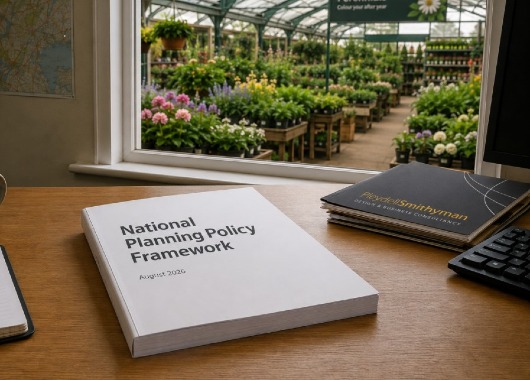
Leading garden centre planning and strategic advisers Pleydell Smithyman are encouraging owners to take a fresh look at their longer-term ambitions following the Government's publication of a significantly revised National Planning Policy Framework (NPPF) on 17 August 2026.
The changes could provide a more positive planning environment for businesses looking to grow, diversify and invest – particularly where development supports the role that rural businesses play in their local communities and economies.
While the changes do not mean that every garden centre development will automatically receive planning permission, they do provide an important opportunity for owners to revisit plans, test previously shelved ideas and consider what the future of their site could look like.
Why should garden centres take notice?
Garden centres have evolved considerably beyond their traditional role as places to buy plants and gardening products. Today, many are significant destinations combining retail, catering, food, leisure, events and experiences. For some businesses, the next stage of growth could involve a new café or restaurant, expanded retail space, improved outdoor trading, visitor attractions or other complementary uses. Planning policy, however, has not always made it straightforward to develop these ambitions in rural locations.
The revised NPPF places greater emphasis on economic growth, investment and the sustainable development of rural businesses, which could be particularly relevant to garden centres.
New Policies S3 to S5 replace the previous approach set out under Paragraph 11 and introduce a more permanent presumption in favour of suitably located development.
Policy S5 identifies development outside settlement boundaries that can benefit from this presumption, including agriculture, horticulture and forestry, outdoor sport and recreation, allotments, and rural businesses and services, including tourism.
The framework also makes clear that an unmet need is not limited to housing. This could provide rural businesses with another way of demonstrating the need for new services or facilities.
From garden centre to destination
The changes could be particularly relevant to garden centres looking at how they can remain competitive and commercially sustainable over the longer term.
Potential opportunities could include:
- Retail expansion – improving or increasing the space available for core and complementary retail.
- Catering investment – creating new cafés, restaurants or food-led experiences.
- Leisure and visitor facilities – introducing attractions or experiences that increase dwell time and repeat visits.
- Outdoor trading – improving plant areas and seasonal outdoor sales environments.
- Diversification – introducing complementary uses that strengthen the overall business.
- Building investment – converting existing buildings or considering new facilities where appropriate.
- Masterplanning – developing a long-term strategy for the whole site rather than considering individual projects in isolation.
The economic policies within the revised NPPF also place significant weight on business investment.
Policy E2 directs “substantial weight” towards investment, expansion and adaptation by businesses, while Policy E4 specifically supports the sustainable growth and diversification of rural businesses, including agriculture, tourism, leisure and local services.
For garden centres, this could be an important shift in the way future development proposals are considered.
Planning should support the commercial strategy
Andrew Burton, Director at Pleydell Smithyman, said: “The Pleydell Smithyman planning team have been reviewing these immediate changes alongside the work we are already doing, and the wider team are now aware of the updates when discussing projects with clients.
“Overall, we are positive about the changes. For someone who doesn't work in planning, the system can sometimes feel like a series of obstacles. What these changes appear to do is provide a clearer framework and, importantly, greater recognition of the contribution that rural businesses make to their local communities and economies.”
Andrew believes the opportunity for garden centres goes beyond simply asking whether a particular development can be approved. “The real opportunity is to step back and think about what the garden centre needs to become in the future. If a business has previously considered expanding its café, introducing a visitor attraction, developing additional retail space or diversifying into other areas and decided not to progress because of planning risk, it could now be worth revisiting those ideas.”
Andrew added: “Planning should not be considered in isolation. The starting point should be the commercial strategy – what does the business need to achieve? Planning then becomes part of understanding how that ambition might be delivered.”
It is not a green light for every project
The revised NPPF does not remove the need for careful planning assessment.
Andrew added “But feedback from our planning team is that there are still important considerations. The sequential test and impact assessments remain, and Green Belt policies have not fundamentally changed. Every site will continue to be assessed on its own merits.
“So, this is not about saying that every garden centre can now expand or diversify without restriction. It is about recognising that the national policy environment has changed and making sure garden centre owners understand what that could mean for their particular business and site.”
A reason to start the conversation
With changing customer expectations and increasing competition for leisure and retail spending, many garden centres are already considering how they can make their businesses more resilient and give customers more reasons to visit.
The revised planning framework could form an important part of that conversation.
Andrew said “We understand that garden centre owners are busy running their businesses and don't necessarily have the time to keep up with every planning policy change. Our role is to understand what they want to achieve, explain what the changes could mean for them in straightforward terms, and help them explore the opportunities in a realistic and commercially sensible way. For garden centres considering their next stage of growth, we believe now is a good time to revisit those plans.”