Finalists announced for the AIPH World Green City Awards 2026
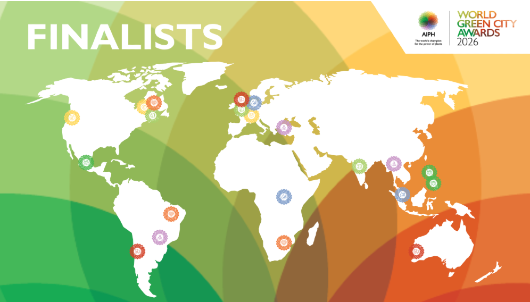
Twenty-one inspiring city greening initiatives have been selected as Finalists for the AIPH World Green City Awards 2026. Each of these cities demonstrate the transformative power of plants in solving some of the most pressing urban challenges - from extreme heat and flooding to food security, biodiversity loss and public health.
Initiated by the International Association of Horticultural Producers (AIPH) and supported by its network of Green City Partners, the AIPH World Green City Awards champion ambitious nature-orientated approaches to city design and operation. The Awards recognise the role of city authorities in promoting and enabling the use of plants as practical tools to improve urban life - supporting climate resilience, restoring ecosystems, strengthening communities, and creating more liveable cities.
Across the 21 Finalists, this is already being put into practice - from transforming streets and restoring degraded land, to expanding urban forests, improving access to green space, and developing new models for food production - demonstrating how planting can deliver measurable environmental, social and economic benefits. In the first of a two-stage judging process, a multidisciplinary Technical Panel reviewed all entries to the Awards and scored them according to six judging criteria. The Finalists comprise the three highest scoring entries in each of the seven Awards categories.
The Finalists are:
Living Green for Biodiversity & Urban Ecosystem Restoration
Surrey’s Green Infrastructure Network - Preserving Biodiversity for Future Generations, Surrey, Canada
Retrofitting Paris into a biodiversity friendly city, Paris, France
The Willow Cure: Natural Decontamination for Urban Brownfield in the city of Montréal, Montréal, Canada
Living Green for Climate Change
Mission Million Trees - Planting 14 million trees in Ahmedabad, Ahmedabad, India
Climate Action: Cool Streets and Greening, City of London, UK
Restoring Montréal’s Riverbanks in a Changing Climate: A Strategic, Ecological and Social Commitment, Montréal, Canada
Living Green for Health & Wellbeing
Cidade da Criança: Nature-Based Early Childhood Infrastructure in Fortaleza, Fortaleza, Brazil
Bringing Resilient and Biodiversity-Rich Forests Back to Ensure Healthy Environments: Montréal Restores High Conservation Value Forests After a Perfect Storm of Invasive Species, Montréal, Canada
The Greening of City of Joburg as Park of Bridging the Green Divide, Johannesburg, South Africa
Living Green for Water
Like Alkmaar, Alkmaar, Netherlands
Melaka River Rehabilitation and Beautification Project, Malacca, Malaysia
Bunia Climate-Shield: A Green Belt for Urban Resilience, Bunia, Democratic Republic of the Congo
Living Green for Social Cohesion & Inclusive Communities
Project Community Garden of Maringá - Environmental and Productive Inclusion, Maringá, Brazil
Sariyer Büyükdere Atatürk Nursery and Gardening School Project, Istanbul, Türkiye
Green City Chiang Rai — Plant Trees, Plant People, Chiang Rai, Thailand
Living Green for Urban Agriculture & Food Systems
Joy is a Farm, Quezon City, Philippines
Programa Altépetl, Mexico City, Mexico
Fish From the Mountains: Bayawan Inland Aquaculture, Bayawan, Philippines
Living Green for Urban Infrastructure & Liveability
Greening the Future - Sheffield’s Model for Climate Resilient Urban Design, Sheffield, UK
City of Perth Urban Greening Strategy 2023-2036, Perth, Australia
Green Infrastructure Plan Vitacura, Vitacura, Chile
An international Jury will assess the Finalist entries based on their capacity for influence, replicability, and scope to inspire change. They will select the seven winning entries for each category, as well as the overall Grand Winner of the AIPH World Green City Awards 2026. A Youth Jury will select a shortlist of three entries that most inspire and meet the needs of young people. Of these three, one will receive the AIPH Youth Award. Further details on the Winners announcement will be confirmed shortly.