North Norfolk is the best place to move to if you love gardening, new research has revealed.
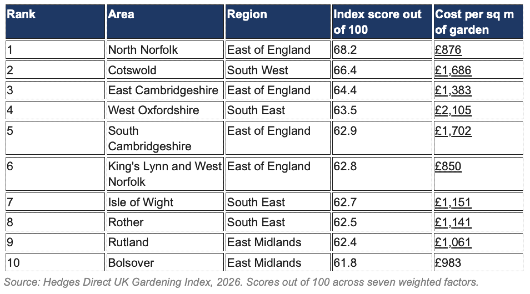
The finding comes from a study by hedging specialists Hedges Direct, which analysed 346 local authorities across Britain on seven key factors that contribute to an ideal set-up for keen gardeners. The metrics include average garden space, climate, soil type and public gardens, which were combined into an index to produce a score out of 100, rating each area's suitability for the horticulturally inclined.
North Norfolk came top of the ranking after scoring well across multiple factors, particularly garden space, with a typical private outdoor space of 346 square metres, the 10th largest in Britain, and 71% above the national figure of 202 square metres. It also performs well for affordability, as an average house price of £303,474 means that garden space comes at a cost of £876 per square metre, which ranks 23rd lowest nationally. The factor it ranks highest on is allotment land, with North Norfolk having 72 sites, which works out at 1.29 hectares per 1,000 homes – the fifth best in the study.
Overall, North Norfolk ranks in the top half for each of the seven metrics that were measured, something only five of the 346 areas manage. It ends up with a final index score of 68.2 out of 100, making it Britain's best place to be a gardener.
The area of Cotswold District Council finishes second overall on 66.4 out of 100, performing best in offering inspiration to gardeners thanks to 29 historic gardens and 35 gardens that are part of the National Garden Scheme and open for the public to visit. When compared against the population size, it ranks best in England and third overall in Britain, behind only Welsh local authorities Powys and Monmouthshire. Cotswold also has the fourth best score for allotment land –there are 68 sites, at a ratio of 1.31 hectares per 1,000 homes.
The third best place to move for gardeners is East Cambridgeshire, on 64.4 out of 100. Its topsoil pH of 6.6 is close to the 6.5 that suits the widest range of garden plants, and it has the longest growing season of the top five, at 288 days, with the national range running from 206 days in Perth and Kinross to a full 365 in the mildest southern and coastal districts. Gardens in East Cambridgeshire are typically 266 square metres, the 54th largest in the study, and the area holds 36 gardens that open to the public.
West Oxfordshire takes fourth place overall with 63.5 points out of 100, and along with Cotswold it is one of only two areas in the overall top five to also finish in the top five for gardens to visit. Just three areas in Britain have more gardens opening to the public than the 74 gardens in West Oxfordshire, and it holds a further 16 historic gardens, which together place it fourth in the country on that factor.
Fifth place goes to South Cambridgeshire, on an overall score of 62.9 out of 100. It has a typical garden size of 258 square metres, the 64th largest, and is home to 45 gardens that open to the public alongside 12 on the historic register.
Eastern England accounts for four of the ten highest-scoring areas, with three from the South East, two from the East Midlands and one from the South West. The Isle of Anglesey in Wales is the highest-placed area outside England, in 12th, and Richmond upon Thames is the best-placed London borough, in 95th. Sefton in Merseyside is the North West’s top place for gardeners, while in the North East the best area is Redcar and Cleveland, and East Riding is number one in Yorkshire and the Humber. Scotland’s ideal location for garden enthusiasts is Na h-Eileanan Siar, also known as the Outer Hebrides.
Commenting on the study, Martin Chaplin, Head of Horticulture at Hedges Direct, said: "The conditions gardeners are working with vary much more than people tend to realise. In some parts of Britain the average temperature is conducive to plant growth nearly all year round, whereas in other areas it is too cold for multiple months, and a typical garden ranges from under 50 square metres in some areas to more than 700 in others, so two gardeners doing exactly the same things in different parts of the country will get very different results.
"Shelter is the other thing that gets underestimated. Wind does more damage to plants in an exposed garden than cold does, and a hedge filters it rather than forcing it over the top the way a solid fence does, which makes a real difference to what will grow in an exposed spot."