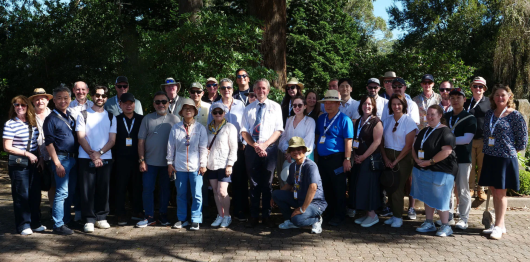
The AIPH Meeting Sydney 2026 brought together global leaders in ornamental horticulture at a critical moment for the industry, as climate pressure, resource constraints, and market shifts reshape production and trade worldwide.
Organised by the International Association of Horticultural Producers (AIPH) with the support of Host Partner Greenlife Industry Australia, AIPH’s Member within the country, the Meeting brought together global expertise from across industry, cities, research, and international Expos. It provided a platform for international dialogue and strategic collaboration across the horticulture community. Alongside formal sessions, the Meeting created valuable opportunities for delegates to connect with peers, share experiences, and build relationships across regions and sectors.
The Meeting highlighted:
- the growing role of horticulture in addressing climate resilience and urban challenges
- the importance of international collaboration on plant health, water, and market systems
- opportunities for shared learning across regions and production systems
Speaking at the opening of the AIPH International Horticultural Expo Conference, AIPH President Leonardo Capitanio said: “Our mission is simple but powerful: to promote the importance of plants in creating a better world. The role of horticulture has never been more important than it is today. Around the world, our industry contributes solutions to some of the most pressing challenges facing society.”
Expanding AIPH’s network
During AIPH’s General Meeting on 9th March, members appointed José Antonio Restrepo Rada as a member of the Board, representing South America. Restrepo serves as Chairman of the Board of Directors of Asocolflores, AIPH’s member organisation in Colombia. His appointment brings the perspective of one of the world’s most significant floriculture regions to the AIPH Board.
The Meeting also strengthened AIPH’s global representation in Asia by welcoming a new member: the Vietnam Ornamental Creature Association (VOCH). Established in 1989, the Association represents more than 700,000 members, including artisans, scientists, and entrepreneurs involved in ornamental plants, landscape design and horticultural production.
Looking ahead to upcoming Horticultural Expos
Expo organisers from across Asia, North America, the Middle East, and Europe shared updates on preparations during the AIPH International Horticultural Expo Conference.
Among the highlights were updates on several forthcoming AIPH-approved International Horticultural Expos. Organisers of GREEN×EXPO 2027 Yokohama, Japan, reported strong international interest and progress in developing a landscape-led Expo site that demonstrates horticultural solutions for sustainable cities.
Thailand also outlined plans for Expo 2029 Korat, themed 'Nature and the Future of Life,' which will showcase biodiversity, sustainable agriculture, and horticultural innovation. Meanwhile, organisers of Expo 2031 Minnesota, USA, presented developments in governance, partnerships and site planning following their approval.
These updates reinforced the role of AIPH-approved Expos as global platforms for demonstrating how horticulture contributes to climate resilience, urban development, and community wellbeing.
Exploring challenges for the industry
The first session of the AIPH Horticultural Industry Conference provided practical insight into how growers and industry leaders are adapting production systems, water use, and plant health strategies. Hosting the Meeting in Australia provided a relevant backdrop, with the region experiencing many of the climate pressures discussed. Strong examples of innovation and industry resilience informed delegates of potential solutions to increasingly global climate challenges.
Shifting market dynamics was the focus of the second session. Mike Mehigan, CEO of Greenlife Industry NSW, set the scene by describing how garden retail is evolving in response to shifting consumer expectations, economic pressures, and new business models. Drawing on Australian and Dutch perspectives, following speakers explored how market research can be used to shape campaigns, reconnecting consumers with the physical beauty and emotional value of flowers and plants.
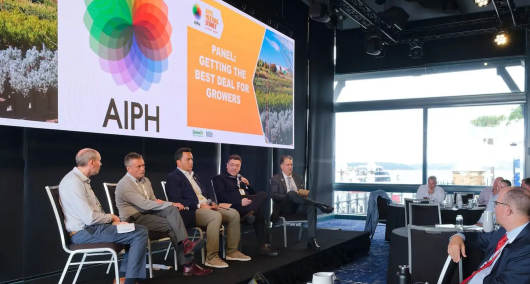
The final session focused on advocacy, with representatives from grower associations in Australia, Canada, Colombia, and Italy sharing experiences of advocating for the horticulture sector in different political and economic contexts. The discussion demonstrated the value of sharing advocacy strategies across regions, enabling participants to learn from different political and regulatory contexts.
Discovering Australian horticulture
On the final two days of the Meeting, delegates toured two well-known horticultural businesses in New South Wales: Tim’s Garden Centre and Andreasens Green. These visits provided international delegates with direct insight into Australian production systems, retail innovation, and landscape delivery at scale.
Known for its welcoming approach, Tim’s Garden Centre in Campbeltown has an exclusive range of plants. Owner Tim Pickles shared how social media has helped build brand awareness and attract customers.
Located in Kemps Creek, Andreasens Green has been operating for over 45 years, providing plants and trees for landscaping projects. Delegates learned about the practical challenges of delivering large-scale landscaping projects and the importance of early collaboration between growers and designers.
Conservation and climate research
Beyond ornamental production, the tour programme also highlighted Australia’s conservation of plant species and the importance of horticulture for combating climate change.
The Plant Bank at Mount Annan’s Botanic Garden not only preserves seeds of Australia’s native plants, it also looks to propagate threatened species. One example is the Wollemi Pine (Wollemia nobilis) – a species that was thought to be extinct until a live specimen was discovered in 1994. The Botanic Garden researched and tested propagation methods, and now, the plant is grown by select nurseries for public sale.
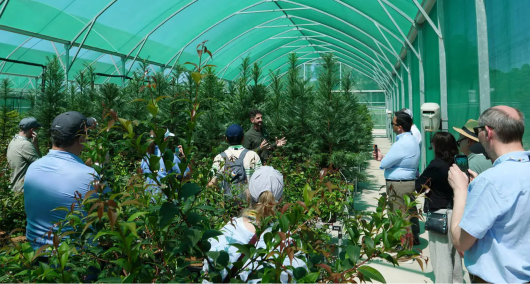
Meanwhile, researchers at the Hawkesbury Institute of the University of Western Sydney are studying the effects of increased CO2 levels on Australian forests to understand what the future landscape might look like and how trees and plants can adapt.
These insights highlighted the role of horticulture and plant science in addressing global climate challenges and biodiversity loss.