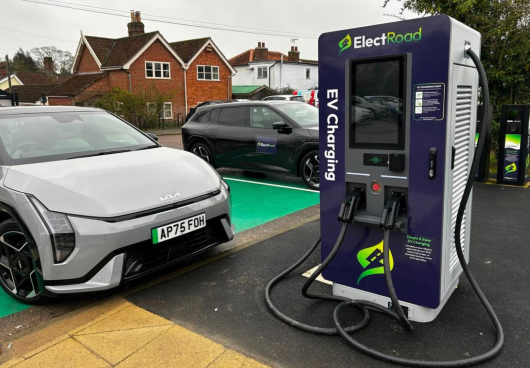
Concerns about power capacity can stop conversations about EV charging before they have properly started. But according to destination charging specialist ElectRoad, the assumption that rapid charging automatically requires an expensive new electricity supply is increasingly outdated.
Electricity capacity is understandably one of the first questions for any garden centre considering EV charging.
Many sites already have significant demands across retail buildings, cafés, restaurants, nurseries, offices and other operations. The prospect of adding rapid vehicle charging can therefore create an immediate concern: will the existing power supply cope, and will an expensive grid upgrade be needed?
ElectRoad founder Richard Seppings believes the mistake is starting with the charger rather than the site.“The first conversation shouldn’t be about how large a charger somebody wants to install,” he explains. “It should be about understanding the energy that is already available, how the site uses it and what charging solution can sensibly operate around that.”
Start with the site, not the hardware
Every destination is different. ElectRoad’s approach is therefore to assess the available grid capacity alongside factors such as existing demand, solar generation and battery storage before determining what charging infrastructure is appropriate.
In some cases additional capacity may ultimately be required. In others, existing resources can support charging more effectively than the retailer initially expects.
Dynamic Load Management is an important part of that equation. The technology allows charging equipment to respond to demand elsewhere on the site, reducing charger output when the building requires more electricity and increasing it again when capacity becomes available.
This means the operation of the garden centre remains the priority rather than charging being allowed to compete with it.
“EV charging should fit around the business,” Richard says. “The idea that you simply connect a large charger and hope the site can support it is completely the wrong way around.”
Solar and battery storage change the calculation
Garden centres can also have characteristics that make them particularly interesting from an energy perspective.
Larger roof areas and available land mean some sites already generate solar energy, while others are considering solar or battery storage as part of wider sustainability or energy-cost strategies.
Solar can provide comparatively low-cost daytime energy when customers are visiting, while battery storage creates the ability to capture power and make it available when required.
Used alongside existing grid capacity and intelligent energy management, these technologies can sometimes make rapid charging viable without the substantial infrastructure work that operators may previously have associated with it.
That does not mean every site will be suitable, and ElectRoad believes that distinction matters.
Not every garden centre should install chargers
One of the most important stages in any charging project should be determining whether it makes commercial and operational sense in the first place.
ElectRoad uses site information to model potential performance and says its own existing data includes installations with different energy arrangements and varying returns. The company’s proposal specifically states that if the numbers indicate charging is not viable for a particular location, it will say so.
Richard believes greater realism will ultimately help retailers make better decisions. “There is no benefit in pretending every garden centre needs exactly the same solution,” he says. “Some locations will have excellent existing capacity. Some will benefit from solar or battery storage. Others may need further investment, and there will be sites where the numbers simply do not work yet.
“The important thing is to establish that from the data rather than making assumptions in either direction.”
A different starting point for EV charging
For garden centres that have previously dismissed charging because of concerns about power supply, the technology and commercial models available today may justify revisiting the conversation.
The question is no longer simply whether a site has spare electricity for a charger.
It is how the grid supply, existing site demand, energy generation, storage and intelligent load management can work together and whether the resulting model makes commercial sense for the retailer. For ElectRoad, that assessment should always come before installation.
Find out more
To find out more about ElectRoad’s destination EV charging solutions for garden centres, farm shops and other retail destinations, visit www.electroad.network.