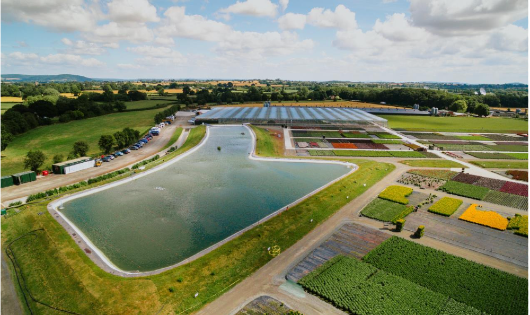
Reservoir at HTA Member Allensmore Nurseries.
The Horticultural Trades Association is calling on the Government to move away from reactive drought management and instead focus on year-round water resilience planning, backed by practical support. This, in turn, will help horticultural businesses invest in water storage, recycling, and efficient irrigation.
In a letter to Environment Secretary Dame Angela Eagle MP, HTA Chief Executive Fran Barnes has urged ministers to reset the National Drought Group as a permanent National Water Resilience Group that meets year-round to plan for future water security, whatever the weather.
The call comes as the HTA publishes the findings of its 2025 Water Consumption & Resilience Survey, which shows water use among professional growers and garden centres accounts for less than 0.2% of the UK's total water consumption, yet 88% of businesses say restrictions on mains or abstracted water would seriously harm or threaten the survival of their business.
The HTA says recent government action, including the COBR meeting on drought and weekly meetings of the National Drought Group, has been welcome in responding to immediate pressures. It also welcomed the reopening of the Water Management Grant and the commitment to publish clearer planning guidance for reservoirs in September. However, the Association says these measures must also work for environmental horticulture and form part of a permanent, year-round approach to water resilience rather than seasonal crisis management.
This summer's drought has highlighted the consequences of the current approach, with some horticultural businesses facing cancelled orders and lost stock, while others continue to face barriers to investing in reservoirs and other resilience measures.
Fran Barnes, Chief Executive of the Horticultural Trades Association, said: “We cannot keep treating drought as a crisis that we manage when it arrives and then move on when the rain comes. Drought is the symptom. Water resilience is the solution – and we need to plan for it all year round.
“This summer has made the consequences very clear. Businesses are losing orders and stock, while those trying to invest in reservoirs, rainwater harvesting and other resilience measures can face significant barriers.
“That is why we are calling for the National Drought Group to be reset as a National Water Resilience Group – one that meets all year round, whatever the weather, and has the focus and urgency to deliver long-term water security.”
The HTA’s research also shows businesses are already investing in resilience. Among the growers surveyed, 32% now obtain water from alternative sources to mains or abstraction, such as rainwater or greywater recycling, compared with 8% in 2020. However, average water storage capacity is only 16% of annual consumption for growers and 20% for garden centres.
The findings show that horticulture is a low-consumption, high-risk sector: it uses a very small proportion of the UK's water, but relies on secure access to water to keep plants alive and businesses operating.
Fran Barnes added: “Our members are already taking action. Growers have significantly increased their use of rainwater and recycled water, while businesses across the sector are investing in efficient irrigation, storage and water-saving technologies.
“But businesses cannot build resilience alone. The cost of infrastructure is high, and planning, funding and regulatory barriers can stand in the way. We should be planning now for how we will capture, store, and manage water in the future.
“The message from horticulture is clear: we want to be part of the solution.
“This summer should be the point at which we stop asking how we manage the next drought and start asking how we make the UK resilient to the next decade of climate volatility.
“We are ready to work with the government to make that happen.”
The HTA is calling for four changes to the UK's approach to water:
1. Reset the conversation from crisis response to long-term resilience
Replace the National Drought Group with a permanent National Water Resilience Group that meets year-round to plan for future water needs and long-term water security.
2. Improve public messaging and water advice
Work with the environmental horticulture sector to provide practical, consistent advice on water efficiency and to improve public understanding of Temporary Use Bans (TUBs), including clearer, more consistent interpretation of restrictions and exemptions. The HTA recently raised concerns with the Water Minister after guidance issued by water companies this summer created uncertainty over what activities were permitted.
3. Remove barriers to on-site water storage
Remove unnecessary barriers to investing in reservoirs, rainwater harvesting, and other on-site water storage, while ensuring that water storage is considered in new development. On-site reservoirs were among the measures most in demand among growers according to the survey findings, with cost and space as key barriers.
The HTA has since welcomed the government's commitment to publish clearer planning guidance for reservoirs in September and is calling for this to support horticultural businesses as well as other water-dependent sectors.
4. Partner with and back UK environmental horticulture
Design grants and planning guidance so environmental horticulture can invest in reservoirs, rainwater capture, recycling and efficient irrigation. The sector has the expertise to improve water resilience through measures such as plant selection, sustainable landscape design, and Sustainable Drainage Systems (SuDS), which reduce runoff and ease pressure on drainage infrastructure.
The HTA is seeking an urgent meeting with Environment Secretary Dame Angela Eagle MP to discuss how the government can work with environmental horticulture and other water-dependent sectors to develop a long-term approach to water resilience.